Muster Treuhand AG
AML file
Beispiel Holding AG
- Relationship opened
- 22.09.2026
- Responsible officer
- Anna Keller
- Identification complete
- 29.09.2026
- Last screening
- 05.10.2026, 84 sources
- Risk class
- increased
Sign-off
AML officer
Management
KYC and AML software for fiduciaries, asset managers and other financial intermediaries
The client fills in the forms and holds their ID and face up to the camera. The system checks them against more than 80 sanctions, PEP and other lists and suggests a risk level. You decide and print the file for the folder.
Early bird: 10% off for the first year. You pay nothing up front.
Developed in Switzerland, built on more than ten years of work as AML officers in financial firms and banks.


Muster Treuhand AG
Beispiel Holding AG

You send the client a link and sign the file at the end. Every step in between is logged and becomes its own page in the file.
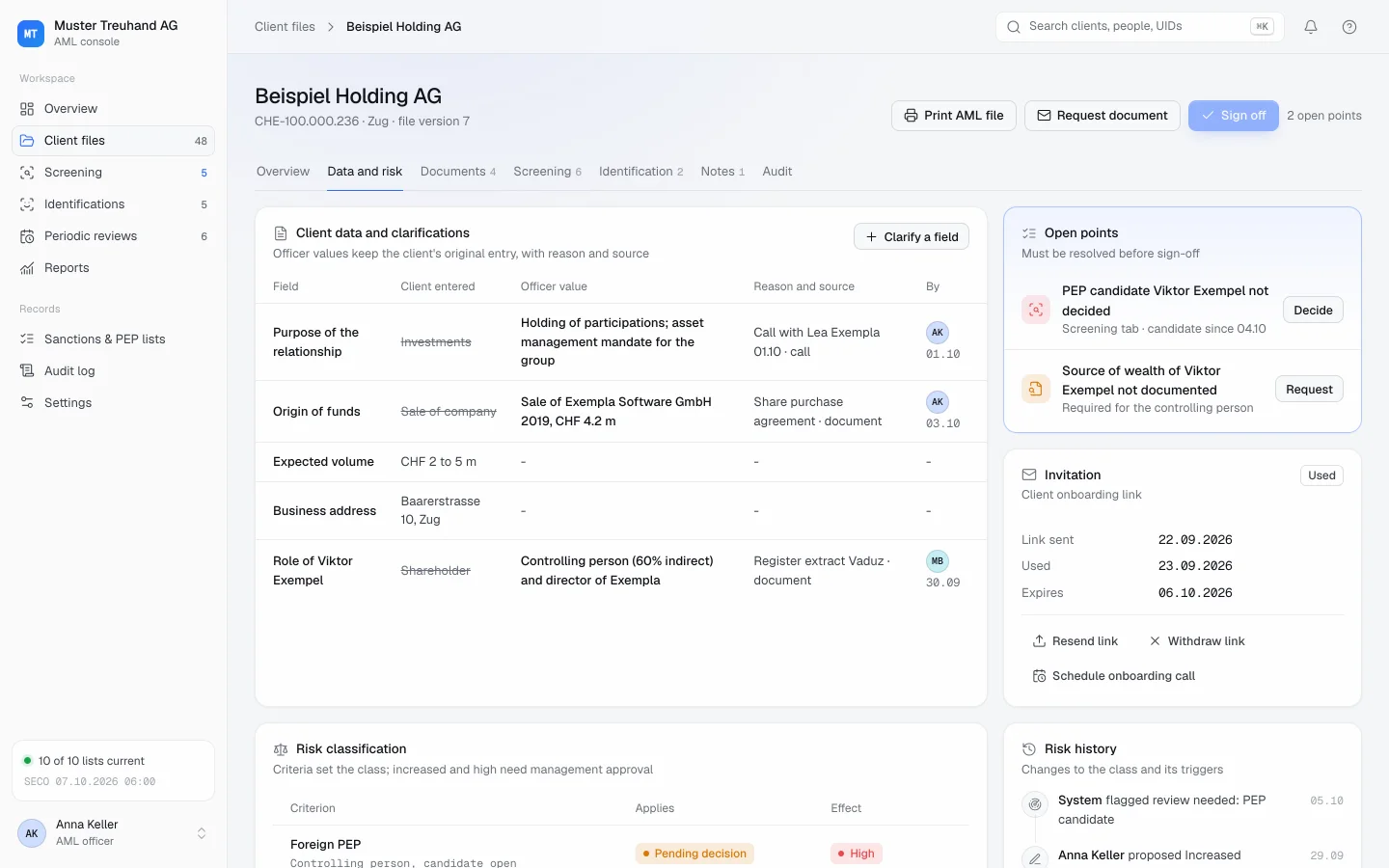
The client receives a personal link and enters company data, Form A or K, the purpose of the relationship and the origin of funds. Before submitting they see everything once more. Where something is missing you add it with a reason and a source; the original entry stays visible.
AMLA Art. 3–4
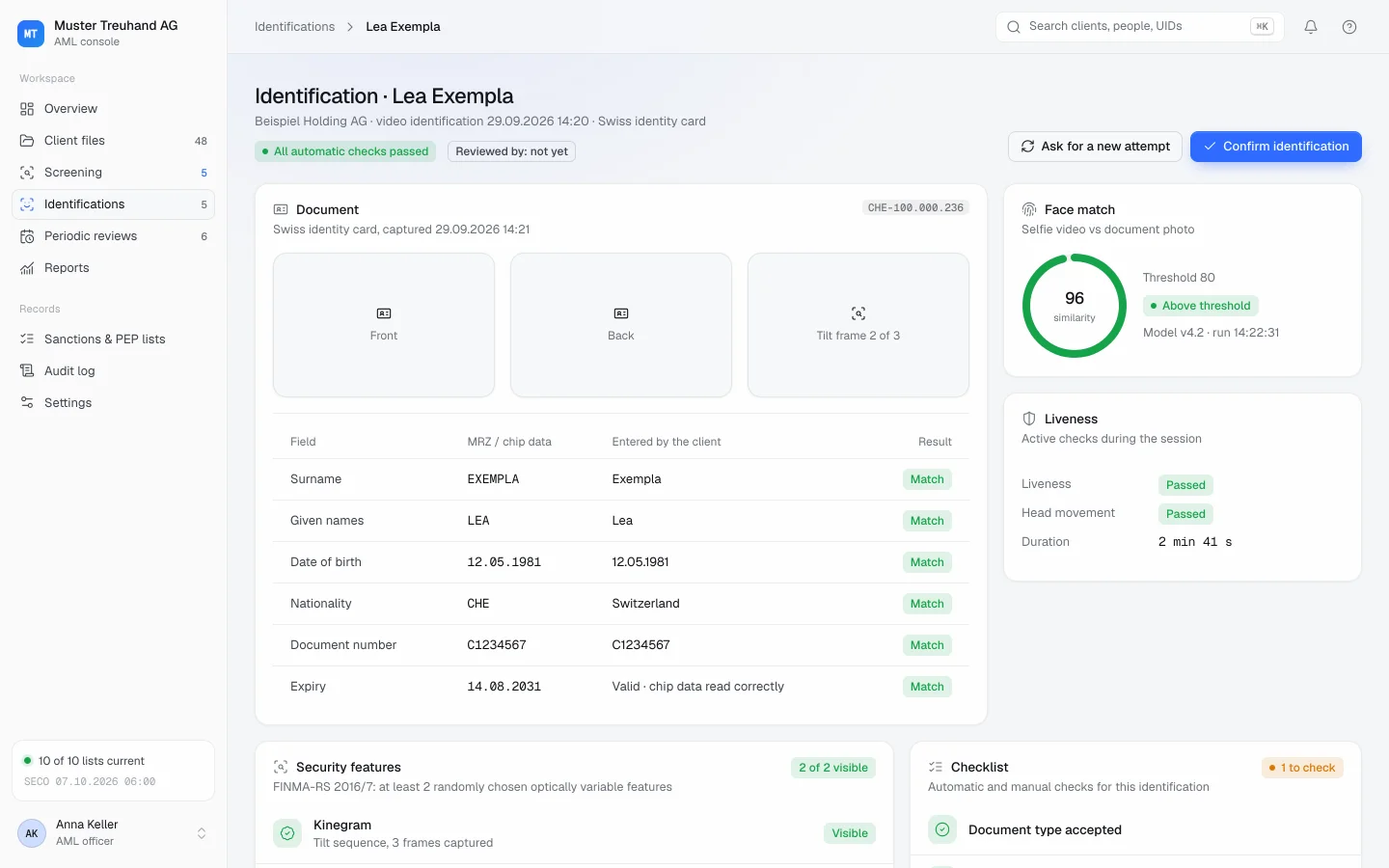
ID document, MRZ data and a face match. The client tilts the passport or ID card as shown on screen; the system picks two security features at random and checks them. Identification by bank transfer is the alternative.
FINMA Circ. 2016/7
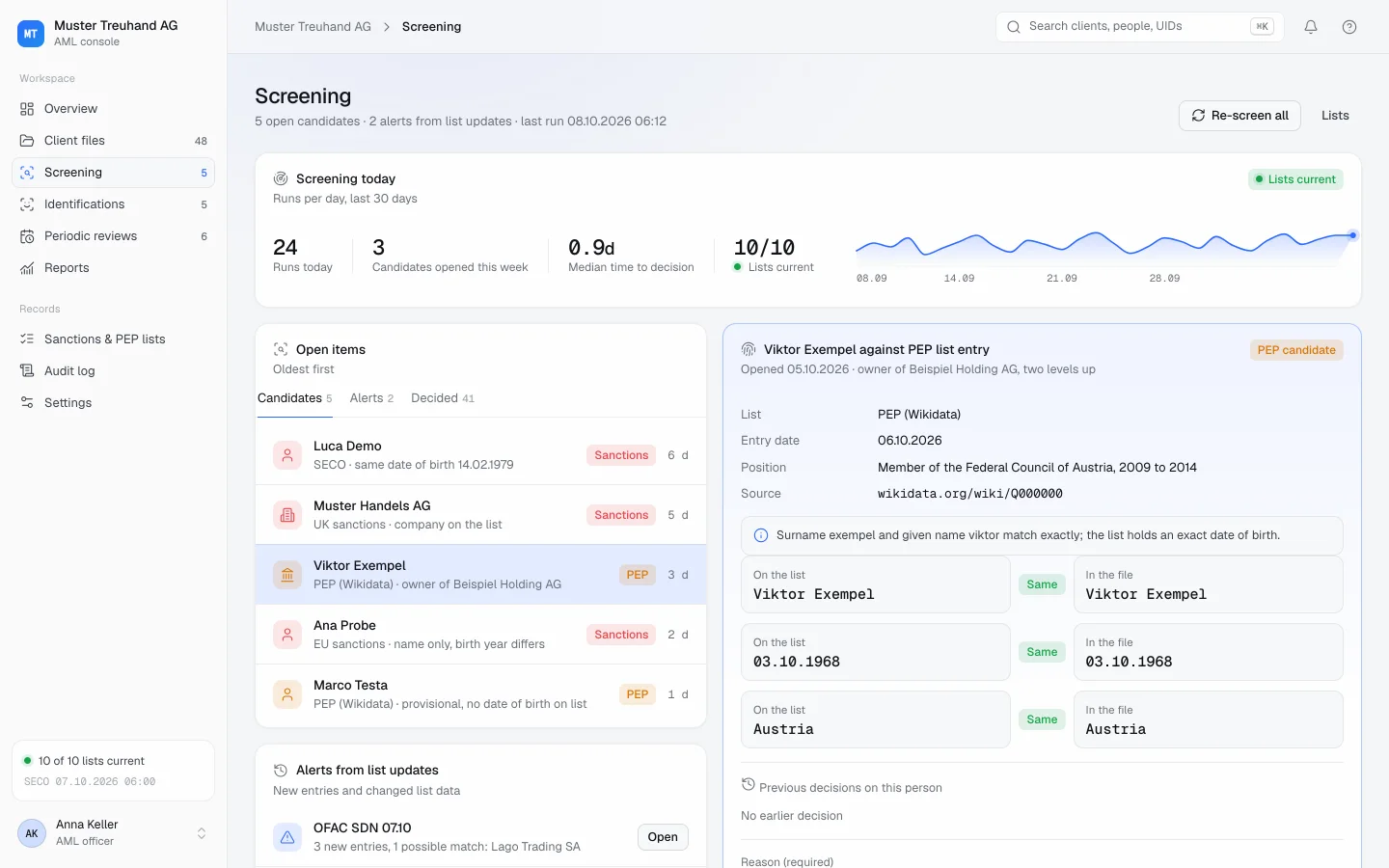
More than 80 sanctions, PEP, debarment and wanted lists. Possible matches go into a queue. You decide whether it is the same person, and the system records your decision and the list version.
AMLA Art. 6
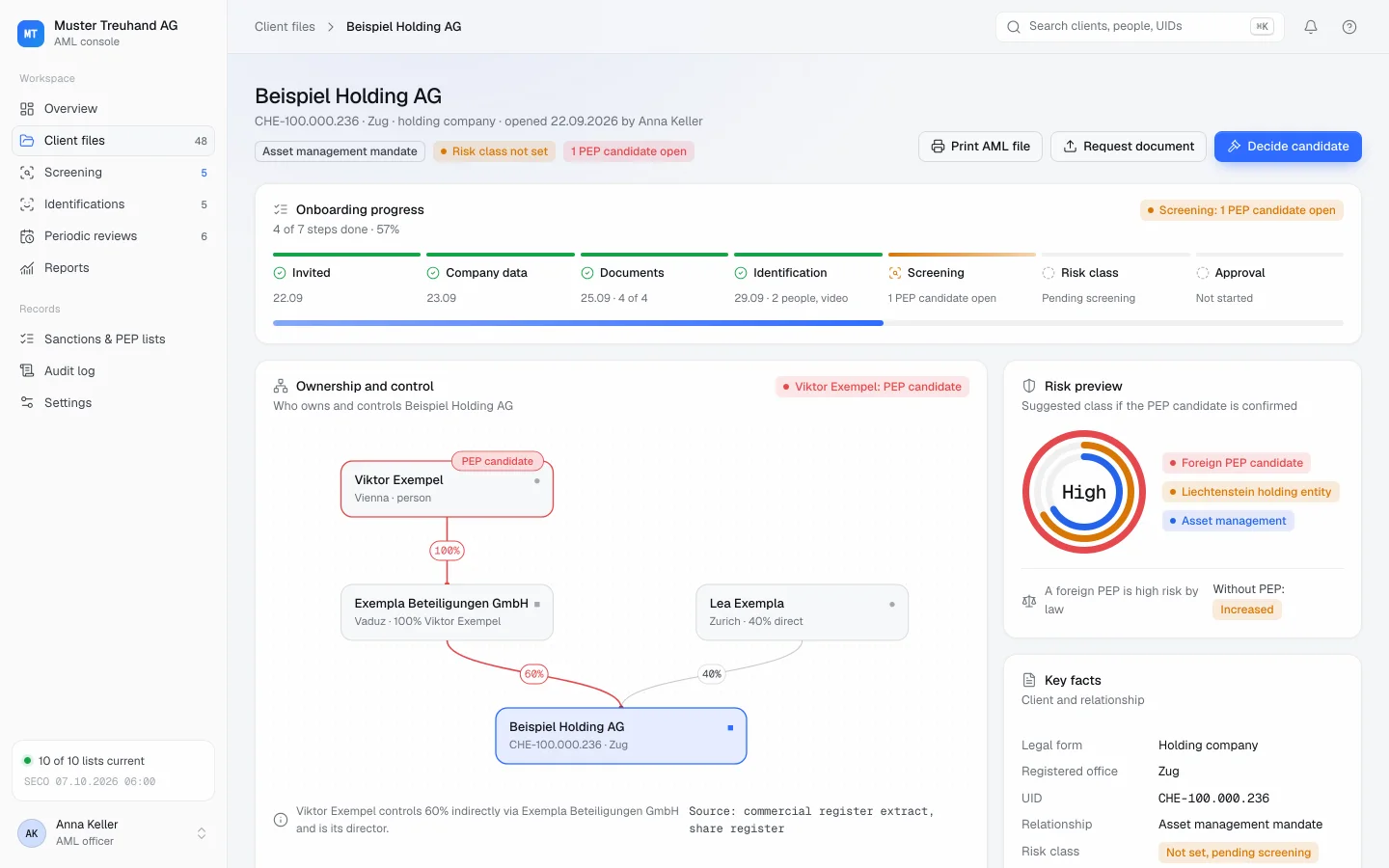
The ownership chain down to the natural person, with levels and shares. Risk classification follows your criteria; increased and high risk go to management for approval.
AMLA Art. 4 and 6
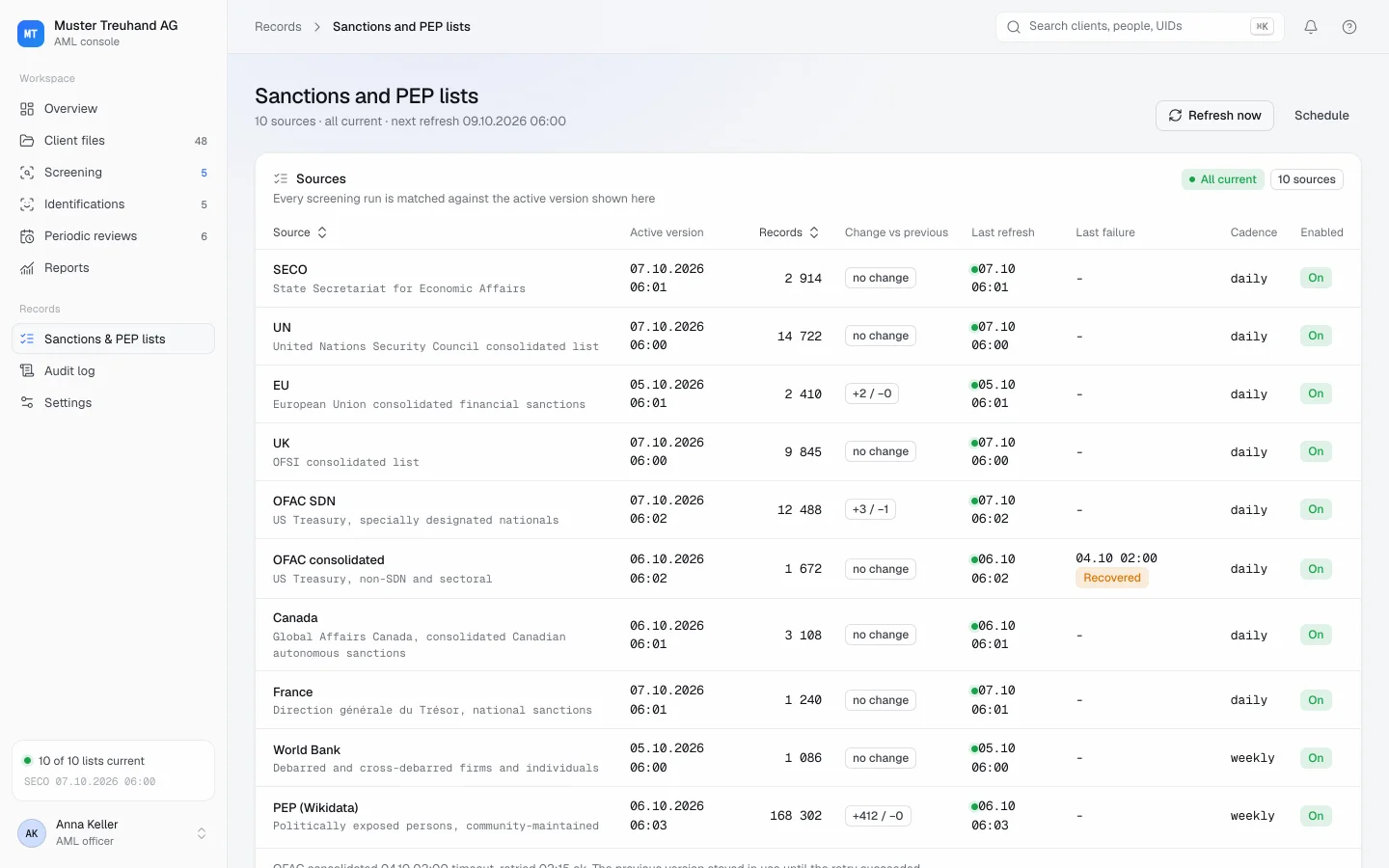
New list versions are checked against every client daily. Commercial register changes and periodic reviews that fall due appear as tasks, not surprises.
AMLA Art. 6
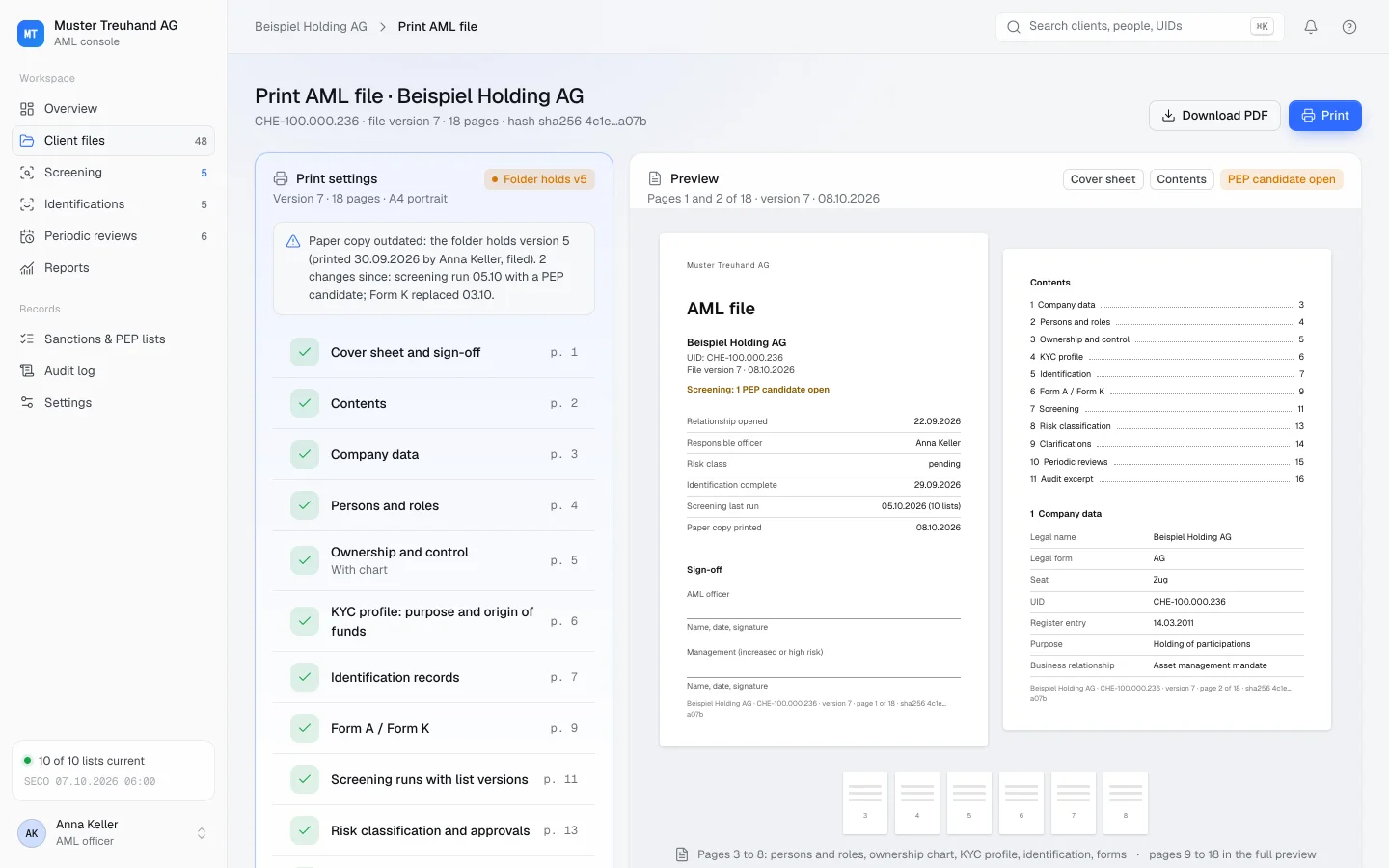
The complete AML file as A4 to print or as a PDF: cover sheet with sign-off and signatures, every section, version and checksum on each page. If anything changes afterwards, the system shows that the paper copy is out of date.
AMLA Art. 7
On the left, what FINMA Circular 2016/7, the AMLA and the SRO rules ask for. On the right, what we added from our own practice.
The system supports your due diligence duties under the AMLA and the checks of FINMA Circular 2016/7. You or your AML officer make the decision in each case.
The system makes suggestions. You make the decisions: every match, every risk level, every sign-off. It does not replace your internal rules or your SRO's audit, and you file reports to MROS yourself. What goes away is the searching, keeping lists up to date and putting the file together.
We are starting with a few firms and set up each environment together with you. Firms that sign up now pay 10% less in the first year and have a say in the next features. You pay nothing up front: for now we only take your details. The more we know about your firm, the better we can set up the pilot.
Place reserved. We will get back to you by email.
As a subscription you pay a fixed monthly price, no matter how many staff use it. On your own server you pay a fixed yearly licence fee. Pilot firms get 10% off the first year. You pay nothing up front.
In Switzerland: with the subscription on servers in Switzerland, with your own installation on your server. Every firm has its own environment; there is no shared database.
One working day, for the subscription and for your own server. After that you can invite your first clients.
To join an SRO you have to name a person responsible for AML. If you don't want to hire one, we take on the role externally and bill by the hour.
Yes. We help with the documents, the internal rules and naming the person responsible for AML.
No. It supports your due diligence duties under the AMLA and the checks of FINMA Circular 2016/7 for online identification. Responsibility stays with your firm.
Yes, in full on A4 or as a PDF. Every page shows the version, page number and checksum. The system records which version is in the folder and shows when it is out of date.
It was developed in Switzerland, based on more than ten years of work as AML officers in financial firms and banks.